How Saatva Connects TV Impressions Directly to Revenue
In 2017, Saatva's Google CPC jumped from $2.80 to over $25. With over 250 new mattress competitors entering the market, bidding their way out wasn't an option. What Saatva’s CMO Joe McCambley did next is worth paying attention to, because the model they built didn't just solve the uncertainty in front of them, it made their whole business more predictable.
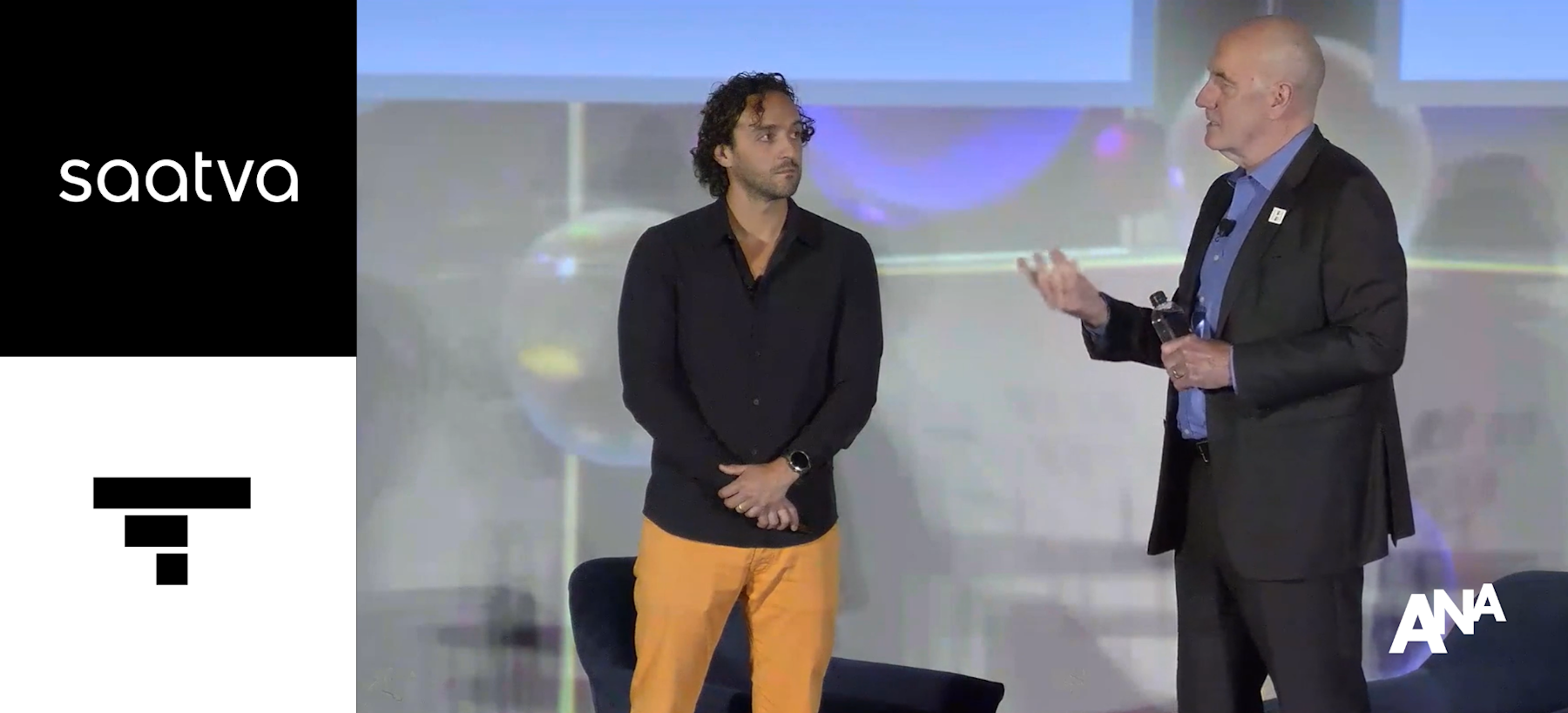
Speaking at ANA Brand Masters in May, McCambley joined Tatari’s Senior Team Lead, Mauricio Lizarazu, to share how they made the shift from performance dependency to full-funnel growth.
Here are a few takeaways from their conversation at ANA Brand Masters:
They changed the word, not the strategy
McCambley's team stopped asking leadership to fund "brand building." They started asking for money for "demand creation." Essentially it was the same investment with verbiage their CFO could buy into.
"No CFO wants to fund brand building," McCambley said. "But when we started calling it demand creation, it's really hard for a CFO to argue against (it)."
Internal framing shapes what gets approved and what gets killed before it can prove itself.
Branded search became their early warning system
TV's results don't show up in revenue immediately. Saatva needed a signal to hold the line in year one, before the downstream impact was visible. Within two weeks of their first upper-funnel investments, including podcasts and radio, branded search volume rose. That early signal became the evidence they used to stay the course.
McCambley called it "excess share of voice." It became the team's internal rallying cry.
Today, over 50% of Saatva's branded search volume can be explained by a single input: the number of TV impressions they put in market. We've written about Saatva's measurement approach before, including how they built similar models to connect TV to retail store sales and phone purchases.
Premium inventory delivered premium results
Saatva's TV evolution ran from opportunistic inventory in linear to more premium streaming media, and eventually into a sponsorship of the break-our hit, Yellowstone. Going one step further, they were signature sponsors of Team USA at the Olympics, which paid off in a way that's hard to fully attribute but impossible to ignore.
"There are some spots that we ran pre-Olympics that we also ran during the Olympics," McCambley said. "Everything leapt because of the Olympic sponsorship."
They built a model that reverse-engineers revenue
The goal was to stop managing by instinct. Saatva built statistical models connecting TV impressions to branded search, non-branded search click-through rates, conversion, AOV, and direct site visits. The result: a model that takes any revenue target and tells them exactly how many impressions they need.
"There's a math that we've been able to identify that runs our business," McCambley said.
Today, Saatva runs across 20 marketing channels and spends less than half the percentage of revenue on marketing it once did. We previously took a deeper look at how Tatari's measurement framework makes this possible, including how TV gets credit for phone sales and retail store visits that would otherwise disappear from attribution.
Uncertainty led to predictability
Saatva's performance team spent money upstream without knowing exactly what it would produce downstream. McCambley was direct about what that felt like — and why pushing through it was the actual competitive advantage.
"You create more demand, and then you wait at the bottom of the funnel to harvest it," he said. "Now the business is much more predictable, and we can say, 'If you want this market share, we have a pretty good idea of where the money is going to go.' Again, it's not perfect, but it's comfortingly predictable."
Watch the full session
McCambley and Mauricio go deeper on the statistical model, the channel mix, and the specific decisions behind Saatva's full-funnel shift. Watch the full session from ANA Brand Masters.
Frequently Asked Questions
What is the TV halo effect, and how does Saatva measure it?
The TV halo effect refers to TV advertising's ability to lift performance across other channels — search, social, direct — beyond what those channels would produce on their own. Saatva measures this by building statistical models connecting TV impression volume to branded search lift, non-branded click-through rates, and conversion rates. Tatari has documented this approach across multiple Saatva campaigns.
How long does it take for TV advertising to show results?
Saatva saw branded search lift within two weeks of their first upper-funnel investments. But McCambley is clear that the full revenue impact takes longer — and that patience in year one is a prerequisite for the predictability that follows. The signal comes early; the scale takes time.
What is "demand creation" vs. "brand building" in TV advertising?
Saatva CMO Joe McCambley reframed their upper-funnel TV investment as "demand creation" rather than "brand building" to win internal buy-in. The strategy was identical — the language made it fundable. The distinction matters because brand building implies soft, hard-to-measure outcomes, while demand creation implies that investment at the top of the funnel directly drives measurable downstream demand.
How do you connect TV impressions to revenue?
Saatva built R-squared regression models linking TV impression volume to branded search, non-branded search click-through, conversion rate, average order value, and direct site visits. The model lets them reverse-engineer any revenue target into a required impression volume. McCambley describes it as "a math that runs our business." Tatari uses a similar geo-lift methodology to measure TV's impact on retail store sales.
Does TV advertising work for DTC brands?
Saatva is a direct-to-consumer brand that built its TV strategy starting from remnant linear inventory and scaled to Olympic sponsorships. Their experience — along with Tatari data from brands at ANA Brand Masters — suggests TV works for DTC specifically because the measurement infrastructure now exists to connect impressions to outcomes across the full funnel.

Michael Goldberg
I lead content at Tatari. When I’m not writing, I’m reading, watching The Office (again), hopelessly rooting for the Mets and Jets, and blasting heavy metal.
Related
How Saatva Pulled Back the Covers on TV-Driven Phone Sales
TV ads don’t just drive clicks—they spark real conversations that convert, and most brands aren’t measuring them. Discover how Saatva uncovered a hidden revenue stream and proved TV’s true impact goes far beyond the website.
Read more
The Secret to How Saatva Quantifies Retail Sales from TV
How do you prove a TV ad led to someone walking into a store days later? Saatva teamed with Tatari to crack the code, and the answer upends how retailers think about attribution.
Read more
How Brands Are Embracing a New TV Advertising Playbook
Discover how marketers are redefining TV as both a performance and brand channel, balancing linear and streaming, measuring halo effects, and making bold, data-driven bets to maximize impact.
Read more