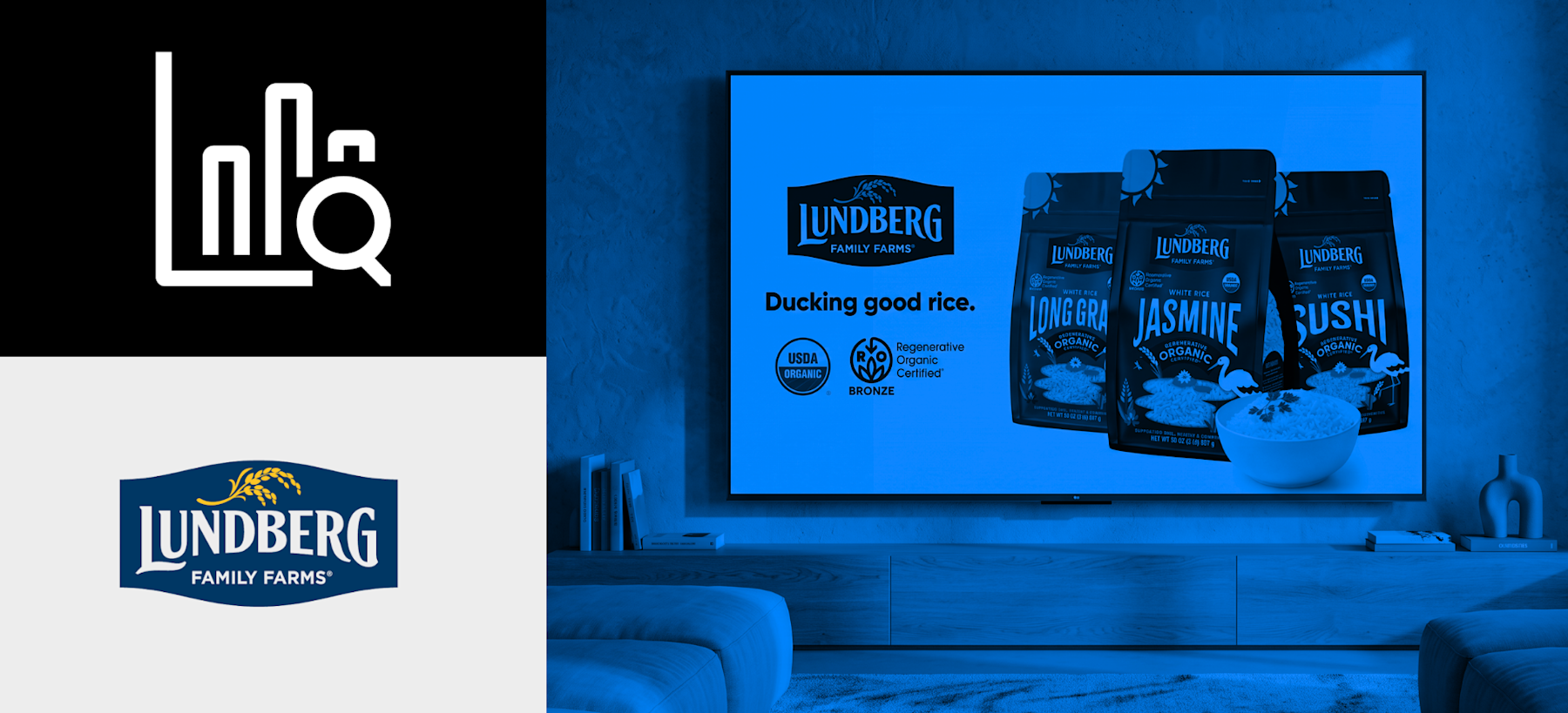
How Lundberg Family Farms Connected TV Ads to Retail Sales
Lundberg Family Farms has spent generations building a brand around organic rice, responsible farming, and a simple idea: leave the land better than you found it. That story doesn't just live on the company's website. It shows up on the shelf at retail stores like Kroger, Target, and natural grocers across the country.
And for a brand like Lundberg, that's exactly where the measurement problem starts.
The Question Most CPG Brands Can't Answer
For brands sold primarily through third-party retailers, the purchase happens far from anything you directly own. A consumer sees a TV ad on Tuesday, remembers the brand on Saturday, and buys a bag of rice at Walmart as part of Sunday dinner. If your measurement framework stops at website traffic or direct e-commerce, that sale is invisible.
Partnering with Tatari, Lundberg ran a TV pilot to answer a question every retail-heavy CPG brand eventually has to confront: can TV actually drive sales of a product at stores they don't own? And can they prove it?
Tatari helped them find out.
Why Standard Measurement Falls Short
A simple before-and-after comparison wasn't going to cut it. Retail sales move for reasons that have nothing to do with the media. Promotions, changes in distribution, regional dynamics, and normal category volatility all play a part in the product being put into somebody’s grocery cart. Collapsing all of that into a single blended number would have buried the signal.
Instead, Tatari analyzed weekly sales at the retailer level, using revenue per store as the primary metric. Revenue per store separates true sales intensity from shifts in how many locations carry the product. Each retailer was measured against its own pre-TV baseline, covering the four-week flight plus two additional weeks to capture delayed lift. Promotional spikes were handled separately rather than folded into the overall model.
Kroger, Walmart, Target, co-ops, and independent retailers don't behave the same way. Measuring them separately gave Lundberg a more precise read on where TV was working and where the signal was harder to isolate.
What the TV Pilot Showed
Across modeled retailers, Tatari estimated a statistically significant result: 0.98 ROAS on nearly $200K in TV spend.
On its own, that's close to breakeven. But the more interesting story is what's underneath.
TV's impact was concentrated in specific retail environments. Kroger delivered the largest estimated dollar impact at $83.8K in incremental sales. This was a modest per-store lift amplified by Kroger's enormous footprint. Natural and independent retailers showed the strongest per-store response: NCG saw an estimated $54.60 lift in revenue per store, while INFRA saw an estimated $12.56 lift per store. That pattern makes sense for Lundberg. Organic, mission-driven food brands tend to resonate most with shoppers already seeking them out in natural grocery channels.
Target and Walmart also showed positive directional signals given that even small per-store gains, spread across hundreds or thousands of locations, can translate into significant total volume.
"We knew TV had an effect on our brand, but we had challenges connecting it directly to what was happening at retail,” said Roberta Greenspan, Sr Director Marketing, Lundberg Family Farms. “Seeing retailer-level impact, especially in natural and co-op accounts, gave us something concrete to bring into our planning conversations. It changed how we think about where and when TV fits in our overall marketing approach."
The Value is in the Nuance
Not every retailer showed clean lift. Some were harder to read because of promotions, store mix, or regional dynamics. That nuance isn't a weakness in the methodology, it's part of what makes it so useful.
A blended ROAS tells you a number. A retailer-level readout tells you where TV is working, which retail environments are most responsive, and where future measurement can be improved. For Lundberg, the pilot didn't just validate that TV could drive retail results. It gave the brand a sharper foundation for planning the next flight.
Lundberg isn't alone in facing this challenge. Any brand that sells primarily through third-party retail runs into the same measurement wall, and CPG brands across the category have started solving it in similar ways.
What CPG Brands Have Learned About Measuring Offline Sales
Measuring TV's impact on sales in stores the brand doesn't own is a common challenge across the CPG category.
Pholicious, the premium instant pho brand that appeared on Shark Tank in 2025, partnered with Tatari and used TV to accelerate its retail expansion with Walmart. Starting with streaming retargeting at $500/week and scaling into linear, the brand aligned its creative directly to in-store availability ("Find Pholicious at Walmart") and used Tatari's measurement to track results. Within three weeks of running linear TV, Pholicious expanded from 500 to 1,900 Walmart stores as an everyday item.
Then there’s Saatva, the luxury mattress brand. They had their own physical showrooms and still faced the challenge of connecting TV advertising to offline sales. Working with Tatari, Saatva built a model that accounted for regional ad spend, carryover effects, holiday periods, and store proximity to attribute 5.7% of total retail sales directly to TV, giving them DMA-level visibility into where campaigns were converting.
What CPG Marketers Need to Know
If your products live on shelves in retail stores, your TV measurement needs to follow the purchase path all the way to the retailer. Website traffic and direct e-commerce still matter, but they systematically undercount TV's contribution when consumers buy through third-party retail. A retailer-level measurement model helps you understand:
Whether TV is generating meaningful retail demand
Which retail accounts are responding — and which aren't
Whether your lift is coming from broader distribution, stronger per-store velocity, or both
For Lundberg, the answer was more useful than any single ROAS number. TV drove measurable impact in select retail environments. Tatari made that impact visible.

Brent White
I’m a Data Scientist at Tatari, where I dive into marketing mix models to help our clients scale. Outside of work, you’ll find me enduring a Chargers game, tinkering with my car, or strolling with my pup
Related

Watch: How Jones Road Scaled TV to 25% of Its Media Mix
Hear how Jones Road broke through a paid social plateau with TV and what they learned along the way, including the real cost of free ad credits.
Read more

How Saatva Pulled Back the Covers on TV-Driven Phone Sales
TV ads don’t just drive clicks—they spark real conversations that convert, and most brands aren’t measuring them. Discover how Saatva uncovered a hidden revenue stream and proved TV’s true impact goes far beyond the website.
Read more
PATTERN Beauty Proves the Beauty of TV for Brand Awareness
PATTERN Beauty proved TV can do more than build awareness—it can drive real growth. See how a strategic mix of CTV and linear TV delivered major lifts in traffic, revenue, and brand consideration.
Read more